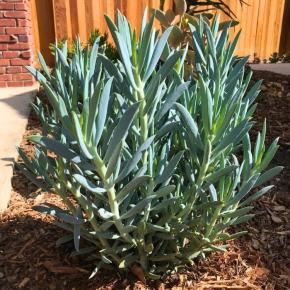
A compact, drought-tolerant succulent, Senecio serpens Dwarf Blue stands out for its striking powdery blue foliage and low, spreading habit. Originating from South Africa, it forms dense mats ideal for xeriscaping, groundcover, or container design. Its resilience to heat, poor soils, and low water input makes it a high-value choice for sustainable landscaping.
|
Packaging
To find out more about our packaging, please visit our young plants' page available from the website header.

|
Available quantity | Dispo à partir de | Sold by | Desired quantity | |
|---|---|---|---|---|---|
|
Le stock n'est actuellement pas disponible pour ce produit. |
|||||
The characteristics of Senecio serpens Dwarf Blue
Native to the arid regions of South Africa, Senecio serpens Dwarf Blue is a compact, perennial succulent valued for its intense powder-blue foliage and spreading form. Its cylindrical, fleshy leaves have a waxy coating that reduces water loss and intensifies the color under full sun. This cultivar remains smaller than the standard Senecio serpens, making it ideal for confined planting spaces. Its summer blooms, though modest, attract pollinators while adding seasonal interest. Highly drought-tolerant and salt-tolerant, it thrives in nutrient-poor, sandy, or rocky soils.
How to use Senecio serpens Dwarf Blue ?
Thanks to its compact habit and vibrant color, Senecio serpens Dwarf Blue is a versatile element in dry gardens, rockeries, and Mediterranean landscapes. It works exceptionally well as a drought-tolerant groundcover, spilling over low walls, or edging sunny pathways. In container compositions, it pairs beautifully with contrasting textures such as ornamental grasses or other succulents. Its tolerance to heat and minimal maintenance needs make it suitable for urban rooftop gardens, coastal landscapes, and low-irrigation public plantings. When mass-planted, it creates a striking, uniform blue carpet effect.
Cultivation guidelines for Senecio serpens Dwarf Blue
Plant Senecio serpens Dwarf Blue in well-drained, sandy or gritty soils to avoid root rot. Optimal planting distance is 30–40 cm to allow spreading without overcrowding. Full sun exposure ensures the most intense foliage color and compact growth. Water sparingly — only when the soil has completely dried — and reduce irrigation during cooler months. Pruning is generally minimal, but removing spent flowers and leggy stems helps maintain form. Fertilization is rarely necessary; however, a light application of low-nitrogen, succulent-specific fertilizer in spring can boost growth. Avoid heavy clay soils unless significantly amended with drainage materials.