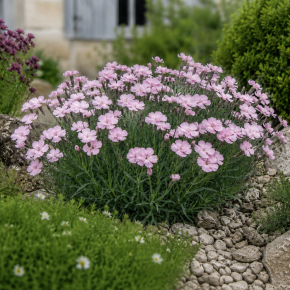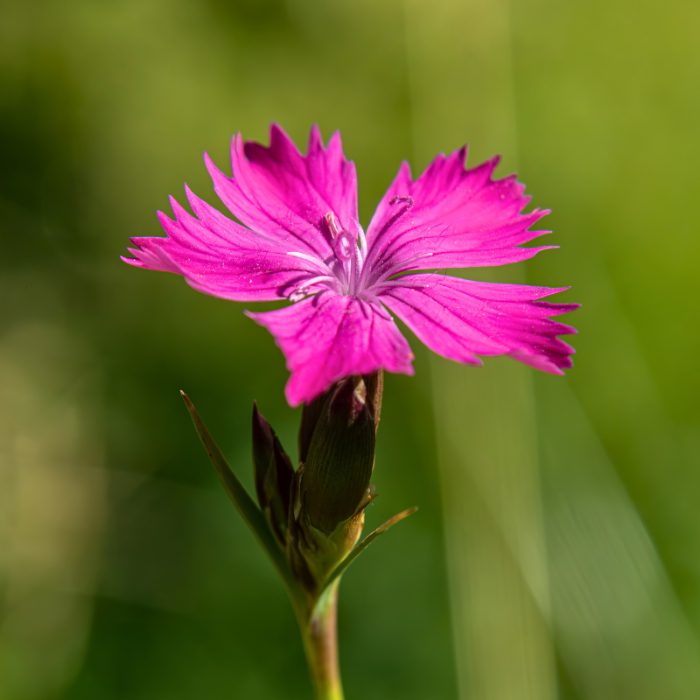
Native to central, southern and western Europe, Dianthus carthusianorum, commonly known as Carthusian pink, is a herbaceous perennial recognised by its compact clusters of purple-pink flowers carried on long, slender, upright stems. Unlike low cushion-forming pinks, its taller, more open habit brings lightness and vertical structure to plantings. Its summer flowering makes it particularly suitable for wildflower meadows, rock gardens and sunny dry borders.
|
Packaging
To find out more about our packaging, please visit our young plants' page available from the website header.

|
Available quantity | Dispo à partir de | Sold by | Desired quantity | |
|---|---|---|---|---|---|
|
Packaging
GT9
To find out more about our packaging, please visit our young plants' page available from the website header.
|
Available quantity 382 | Dispo à partir de Immédiat | Sold by min 10 |
|
|
Characteristics of Dianthus carthusianorum
Dianthus carthusianorum forms a narrow clump of linear green leaves, from which slender upright flower stems rise to around 50 cm. At their tips, dense clusters of small purple-pink to magenta flowers appear, surrounded by brownish bracts. This distinctive floral arrangement makes the species easy to distinguish from many other perennial pinks. Despite its height, its overall silhouette remains light and airy, allowing it to blend naturally into meadow-style plantings. Flowering mainly occurs from June to September. This species performs best in bright, warm positions and in well-drained soils, particularly calcareous soils, and tolerates dry periods once properly established.
How to use Dianthus carthusianorum?
Dianthus carthusianorum is particularly suitable for wildflower meadows, rock gardens, slopes, dry gardens and sunny perennial borders. Its fine, upright habit allows it to be planted among ornamental grasses and other perennials without creating an overly dense mass. It combines well with yarrows, salvias, scabious and other plants adapted to dry conditions. Planting in groups or repeated drifts helps emphasise its vertical stems and small purple-pink flower clusters. It is also well suited to poor, stony or calcareous soils where drainage is effective. Container cultivation is possible, although its natural habit is generally better displayed in open-ground plantings.
What are the best cultivation tips for Dianthus carthusianorum?
Plant Dianthus carthusianorum in full sun, in light, well-drained soil that is poor to moderately fertile. It tolerates stony and calcareous ground well, while heavy soils that remain wet for long periods should be avoided. Allow approximately 30 cm between plants. Water regularly after planting while the root system becomes established, then reduce irrigation; once established, this pink tolerates dry periods. Remove faded flower heads if you wish to limit self-seeding or maintain a tidier appearance. Heavy fertilisation is unnecessary, and excessive nitrogen can encourage softer growth and reduce the plant’s overall stability.