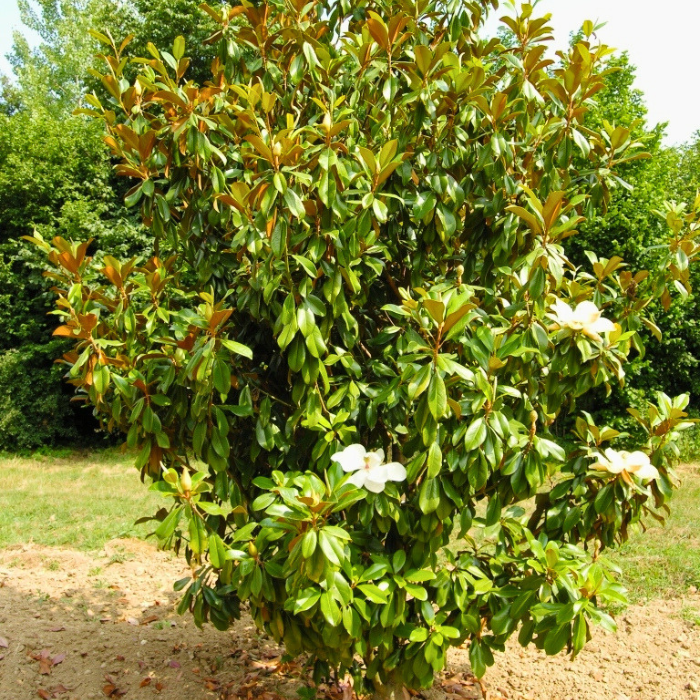
Magnolia grandiflora Le Nantais is a traditional, elegant cultivar of evergreen magnolia, prized for its early and generous summer flowering and its glossy, persistent foliage with rust-colored undersides. Ideal for medium to large gardens, whether as a specimen tree or in aligned plantings, it offers year-round ornamental value combined with a strong summer floral display.
|
Packaging
To find out more about our packaging, please visit our young plants' page available from the website header.

|
Available quantity | Dispo à partir de | Sold by | Desired quantity | |
|---|---|---|---|---|---|
|
Le stock n'est actuellement pas disponible pour ce produit. |
|||||
Characteristics of Magnolia grandiflora Le Nantais
Le Nantais is a cultivar of Southern Magnolia selected for its early and abundant flowering, even in young specimens. Its large, glossy, leathery leaves are dark green on top with a velvety copper-brown underside, providing year-round structure and visual interest. In summer, it produces creamy white, fragrant, solitary flowers — often more prolifically than traditional types. With moderate growth, a broad yet elegant shape, and reliable hardiness for an evergreen magnolia, this cultivar is well-suited for temperate regions when provided with suitable soil and exposure.
How to use Magnolia grandiflora Le Nantais ?
This evergreen magnolia Le Nantais performs well as a specimen tree in open lawns, in alignment along paths or property boundaries, or as a loose, ornamental hedge. Its structural form and persistent foliage offer screening and visual depth throughout the year. Suitable for medium to large-scale gardens, it provides vertical interest and shade, while the summer flowering phase adds sensory appeal. It integrates beautifully into both traditional and contemporary landscape compositions where permanent greenery and seasonal blooms are valued.
Best practices for cultivating Magnolia grandiflora Le Nantais ?
Prefers deep, humus-rich, moist but well-drained soils; slightly acidic to neutral pH is ideal. Plant it in full sun to partial shade, protected from cold drying winds, dig a planting hole 2–3 times wider than the root ball. Loosen the soil and amend with compost or organic matter if needed. Ensure thorough watering after planting and during dry spells. While hardy to –15 °C, it benefits from mulching or shelter in exposed or colder climates, especially during the establishment phase. Requires little pruning — only remove dead or poorly positioned branches after flowering. Mulch regularly to conserve soil moisture and suppress weeds.