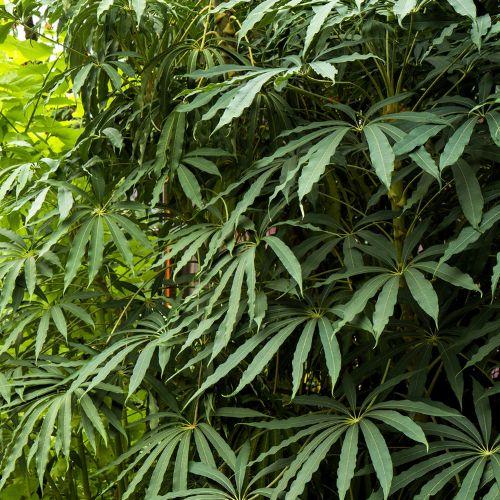
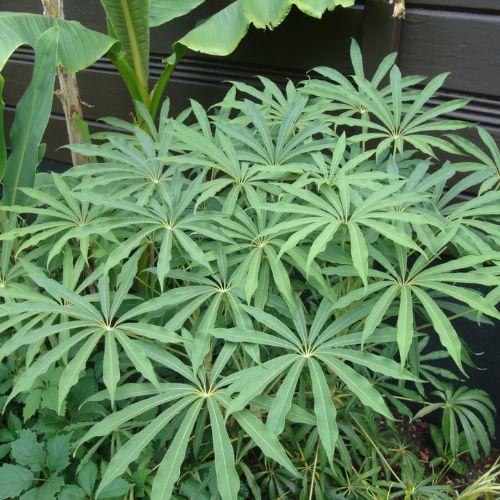
Native to the humid forests of Taiwan, Schefflera taiwaniana stands out with its elegant, upright habit and finely palmate evergreen foliage. Unlike most Schefflera species, it offers notable cold hardiness (down to -10 °C), making it a valuable option for temperate, humid climates. Perfect for bringing a lush, exotic aesthetic even in open ground.
|
Packaging
To find out more about our packaging, please visit our young plants' page available from the website header.

|
Available quantity | Dispo à partir de | Sold by | Desired quantity | |
|---|---|---|---|---|---|
|
Packaging
To find out more about our packaging, please visit our young plants' page available from the website header.
|
Available quantity 95 | Dispo à partir de Immédiat | Sold by |
|
|
Characteristics of Schefflera taiwaniana
Schefflera taiwaniana is a structural evergreen shrub prized for its refined, tropical appearance. Its large, finger-like compound leaves radiate symmetrically, creating an exotic canopy effect year-round. Native to subtropical mountain regions, this species produces understated but attractive late-summer inflorescences. It is one of the few hardy Scheffleras, tolerating frosts down to -12 °C, making it suitable for sheltered outdoor settings in mild coastal or temperate zones.
How to use Schefflera taiwaniana ?
Schefflera taiwaniana is highly versatile in shaded or semi-shaded landscaping. It works well as a standalone specimen, as a backdrop in woodland borders, or in exotic-themed planting schemes. Its structural quality and lush foliage also make it ideal for large containers on shaded patios. It pairs effectively with ferns, fatsias, and other shade-loving understory plants, helping to create immersive, layered garden compositions with year-round interest.
Best practices for growing Schefflera taiwaniana
Plant Schefflera taiwaniana in well-drained, humus-rich, slightly acidic to neutral soil. A spacing of 1.5 to 2 m between plants is recommended to accommodate its spread. Water regularly during the establishment phase; once mature, the plant requires moderate watering, with care taken to avoid waterlogging. Apply organic mulch in spring and autumn to retain soil moisture and insulate roots in colder months. Pruning is generally unnecessary but can be performed in late winter to maintain structure. In marginal climates, a mulch layer will help protect the root zone during frost periods.