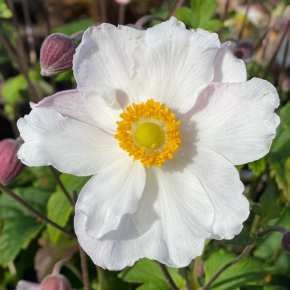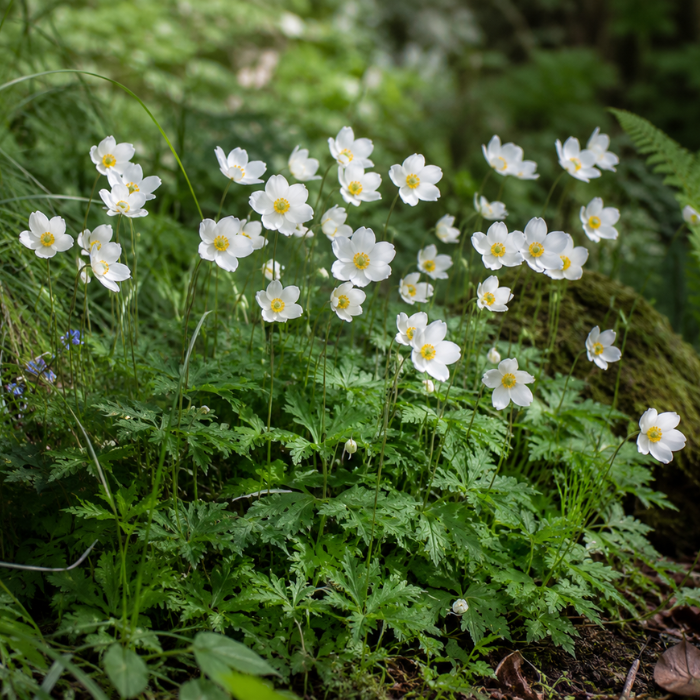
Anemone sylvestris, native to the temperate regions of Eurasia, is a rhizomatous perennial commonly known as the snowdrop anemone or wood anemone. Unlike autumn-flowering Japanese anemones, it produces large white flowers with golden-yellow stamens in spring. Its suckering root system gradually forms a dense ground cover, particularly suited to woodland edges, open woodland and perennial borders.
|
Packaging
To find out more about our packaging, please visit our young plants' page available from the website header.

|
Available quantity | Dispo à partir de | Sold by | Desired quantity | |
|---|---|---|---|---|---|
|
Packaging
GT9
To find out more about our packaging, please visit our young plants' page available from the website header.
|
Available quantity 200 | Dispo à partir de 04/2027 | Sold by min 10 |
|
|
The stated dimensions represent an average mature size. The plant may spread beyond this width where its suckers are not restricted.
Characteristics of Anemone sylvestris
This herbaceous perennial forms a clump of long-stalked, mid-green, deeply divided leaves. In spring, slightly downy flower stems rise above the foliage and carry white flowers measuring up to approximately 8 cm in diameter. Their tepals surround a centre composed of numerous golden-yellow stamens. Flowering occurs mainly in May and June, considerably earlier than that of Japanese anemones. The above-ground growth disappears in winter, while the perennial crown remains dormant in the soil. Its root system readily produces suckers and may form an extensive colony where growing conditions are favourable.
How to use Anemone sylvestris?
The snowdrop anemone is suitable for open woodland, bright woodland edges, naturalistic borders and perennial planting schemes. Its suckering growth enables it to gradually cover the ground beneath deciduous shrubs or fill spaces between larger plants. It combines well with low-growing ferns, hardy geraniums, heucheras, hostas and spring-flowering bulbs. Allow sufficient space for its spread or install a root barrier where expansion needs to be controlled. Container cultivation is possible in a wide, well-drained pot, although regular division will be required. Its flower stems may also be used in fresh floral arrangements.
What are the recommended cultivation practices for Anemone sylvestris?
Plant in spring or autumn in fertile, humus-rich and well-drained soil that remains moderately moist during the growing season. Full sun is suitable in temperate regions where the soil does not dry out excessively, while partial shade is preferable in warmer locations. Allow approximately 40 cm between plants. Loosen the soil before planting and incorporate mature compost where organic matter is limited. Water regularly during establishment and throughout prolonged dry periods. Apply compost in spring. Cut back the flower stems after flowering and divide established clumps in early spring to control their spread.