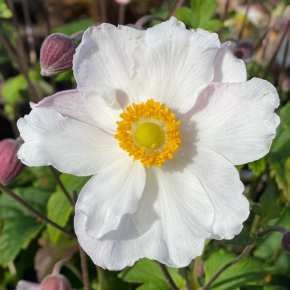
Anemone hupehensis, native to Asia from Nepal to Taiwan, is the botanical species from which many Japanese anemones originate. It differs from taller hybrids through its generally more moderate growth, single pale pink to mauve flowers and suckering root system. Its late flowering period, held above dense foliage, provides structure in borders from August to October.
|
Packaging
To find out more about our packaging, please visit our young plants' page available from the website header.

|
Available quantity | Dispo à partir de | Sold by | Desired quantity | |
|---|---|---|---|---|---|
|
Packaging
GT9
To find out more about our packaging, please visit our young plants' page available from the website header.
|
Available quantity 225 | Dispo à partir de Immédiat | Sold by min 10 |
|
|
The stated dimensions represent an average mature size. Flower-stem height may vary according to soil fertility, exposure and water availability.
Characteristics of Anemone hupehensis
This herbaceous perennial forms a basal clump of dark green, toothed leaves divided into three lobes. In late summer, slender, branched and upright flowering stems rise above the foliage. They carry single, cup-shaped flowers, generally composed of five to seven pale pink or mauve tepals arranged around a green centre surrounded by yellow stamens. The above-ground growth disappears during winter before emerging again in spring. The root system gradually produces suckers and may form a spreading colony. In the botanical classification adopted by Kew, the accepted name is Eriocapitella hupehensis, although Anemone hupehensis remains widely used in horticulture.
How to use Anemone hupehensis?
This anemone is suitable for the middle of perennial borders, bright woodland edges, woodland-style gardens and naturalistic planting schemes. Its late flowering period extends the seasonal display after many summer perennials have finished blooming. It combines well with ferns, hostas, heucheras, asters and ornamental grasses. Planting in groups of three to five specimens strengthens the visual effect of the flowers above the foliage. It may also be grown beneath deciduous shrubs, provided that the soil remains sufficiently moist. Container cultivation is possible in a large pot, although its suckering root system is better suited to open-ground planting. The flower stems may also be cut for bouquets.
What are the recommended cultivation practices for Anemone hupehensis?
Plant in spring or autumn in fertile, humus-rich, moisture-retentive and well-drained soil. Bright partial shade generally provides the most consistent growing conditions. Full sun is suitable where the soil retains sufficient moisture; avoid hot, dry positions and soils that remain waterlogged during winter. Allow approximately 50 cm between plants. Loosen the soil deeply and incorporate mature compost before planting. Water regularly during establishment and throughout prolonged dry periods. An organic mulch may help reduce soil-moisture loss. Apply compost in spring, then cut back the dry stems after flowering or in late winter.