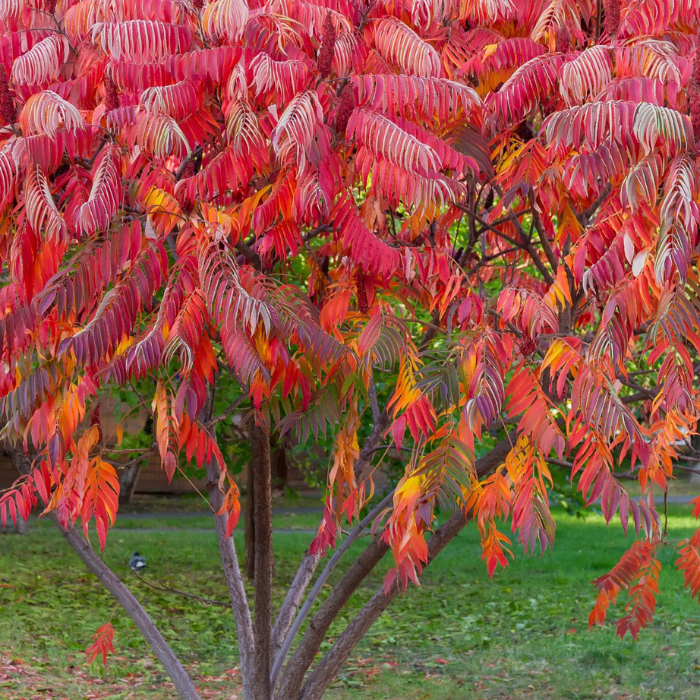
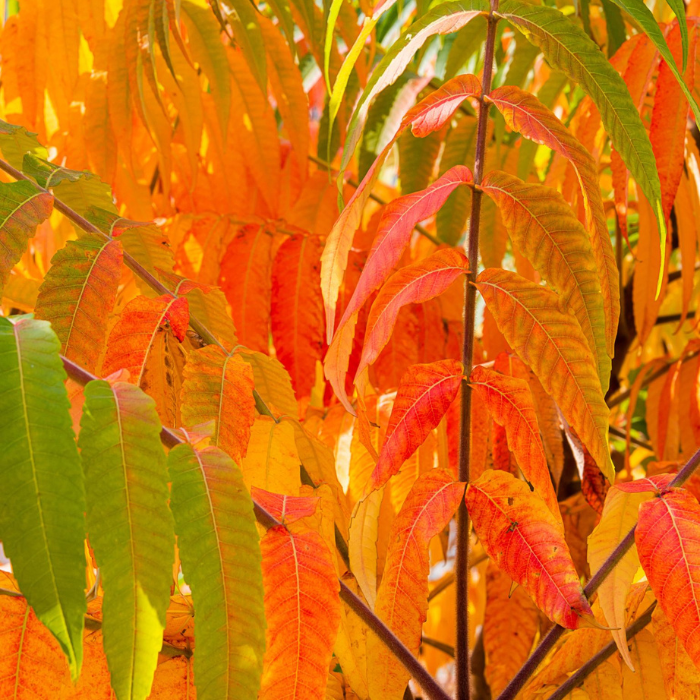
Rhus typhina, native to eastern North America, is a deciduous shrub or small tree valued for its architectural habit and large compound leaves. The staghorn sumac is especially distinctive for its densely hairy young shoots, orange-red autumn foliage and, on female plants, upright clusters of dark red fruits that can remain decorative into winter.
|
Packaging
To find out more about our packaging, please visit our young plants' page available from the website header.

|
Available quantity | Dispo à partir de | Sold by | Desired quantity | |
|---|---|---|---|---|---|
|
Packaging
AF350
To find out more about our packaging, please visit our young plants' page available from the website header.
|
Available quantity 296 | Dispo à partir de Immédiat | Sold by 28 |
|
|
|
Packaging
AF350
To find out more about our packaging, please visit our young plants' page available from the website header.
|
Available quantity 70 | Dispo à partir de Immédiat | Sold by 28 |
|
|
Characteristics of Rhus typhina
Rhus typhina develops several trunks or stems and gradually forms a broad, often irregular silhouette. Its large pinnate leaves, made up of numerous toothed leaflets, turn yellow, orange and then red in autumn. The young shoots are covered with dense velvety hairs, resembling the velvet on deer antlers, which explains the common name staghorn sumac. The species is dioecious, with male and female flowers carried on separate plants. After pollination, female specimens produce upright conical clusters of dark red fruits. Its suckering root system allows the plant to spread gradually and form colonies.
How to use Rhus typhina?
Rhus typhina is mainly used as a specimen plant, in shrub borders, informal hedges or on large banks and slopes, where its spreading habit and autumn colours can be fully appreciated. Its suckering root system should be taken into account, so it is best planted where its spread can either be accepted or controlled. It is therefore more suitable for larger gardens and extensive landscape schemes than for small, highly structured borders. Its winter framework, velvety shoots and, on pollinated female plants, upright fruit clusters extend its ornamental value beyond the growing season. Long-term container cultivation is generally not recommended.
What are the key cultivation tips for Rhus typhina?
Plant Rhus typhina preferably in full sun to encourage the best autumn colour, in well-drained soil. It adapts to a range of soil types and, once established, tolerates relatively poor soils. Allow approximately 3 to 4 m between plants where unrestricted development is desired. Water regularly after planting to encourage root establishment, then adjust irrigation according to rainfall and soil type. Pruning is generally unnecessary and should mainly involve removing dead wood or poorly positioned branches. Monitor and remove suckers where spread needs to be restricted. Heavy fertilisation is usually unnecessary.