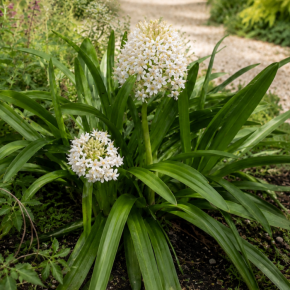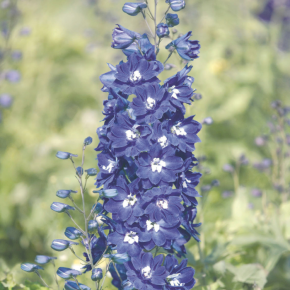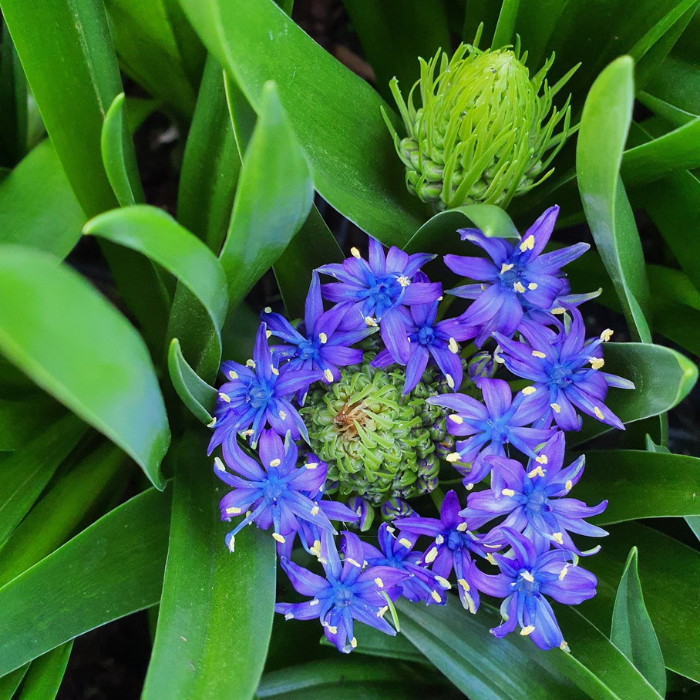
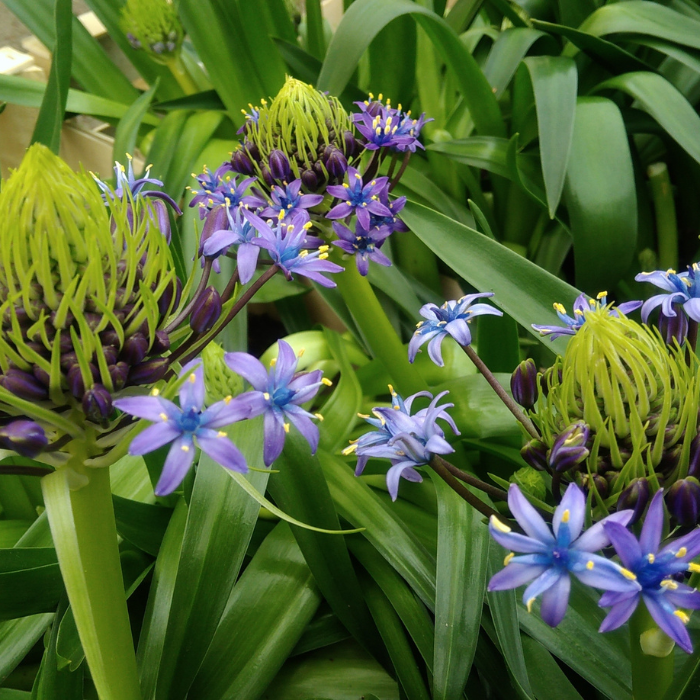
Scilla peruviana, native to the western and central Mediterranean basin and not Peru despite its common name, is a bulbous perennial notable for its large conical clusters of numerous blue-violet, star-shaped flowers. More striking in bloom than many smaller spring-flowering squills, it forms a dense rosette of dark green, strap-like leaves and provides a strong architectural accent in spring planting schemes.
|
Packaging
To find out more about our packaging, please visit our young plants' page available from the website header.

|
Available quantity | Dispo à partir de | Sold by | Desired quantity | |
|---|---|---|---|---|---|
|
Packaging
POT11
To find out more about our packaging, please visit our young plants' page available from the website header.
|
Available quantity 86 | Dispo à partir de 11/2026 | Sold by min 10 |
|
|
Characteristics of Scilla peruviana
Scilla peruviana is a bulbous geophyte belonging to the Asparagaceae family and naturally occurring in several regions of the Mediterranean basin. It develops a rosette of narrow to lance-shaped, dark green leaves, from which sturdy flower stems emerge. These carry broad, conical inflorescences made up of numerous star-shaped blue-violet flowers. The plant generally reaches around 30 cm in height with a similar spread. It performs best in full sun or partial shade and has a hardiness of approximately -10°C, provided that the soil is sufficiently well drained.
How to use Scilla peruviana?
With its dense flowering and compact habit, Scilla peruviana is well suited to flower beds, borders, rock gardens and gravel gardens. It can also be grown successfully in containers on terraces and patios. In open ground, planting several bulbs together creates a stronger visual impact when the blue-violet flower heads appear. It combines well with low-growing perennials and other bulbous plants suited to free-draining soils. In regions with cold, wet winters, select a sheltered position and ensure particularly effective drainage around the bulbs.
What are the best cultivation tips for Scilla peruviana?
Plant Scilla peruviana in full sun or partial shade in light, well-drained soil, as bulbs do not tolerate prolonged waterlogging. For landscape planting, allow approximately 25 to 30 cm between bulbs. Plant them at a depth of around two to three times the height of the bulb. Water after planting and during establishment whenever the soil begins to dry, while avoiding saturated conditions. No specific pruning is required: remove faded flower stems and leave the foliage in place while it remains active. In poor soils, a moderate application of well-decomposed organic matter can support establishment and growth.