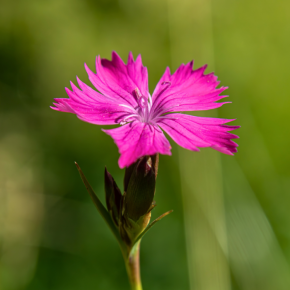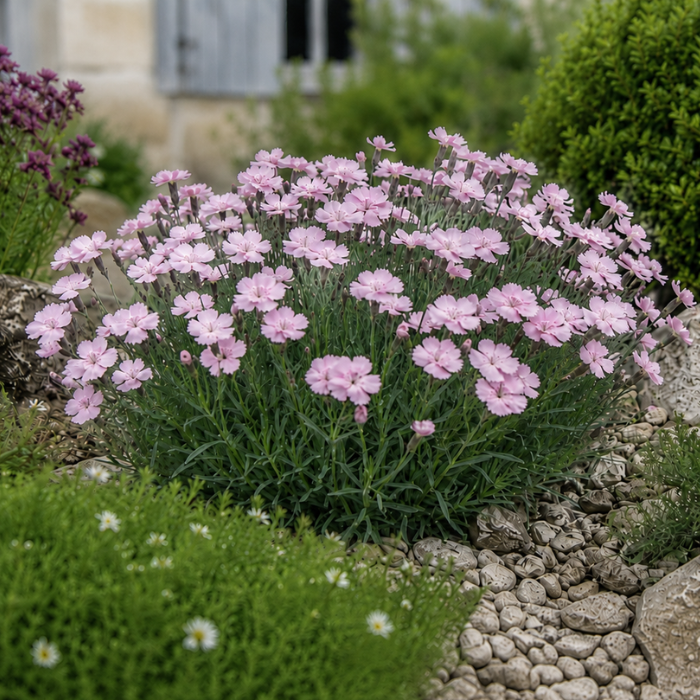
Native to Corsica and Sardinia, Dianthus corsicus, commonly known as Corsican pink, is a compact Mediterranean perennial forming low clumps of narrow foliage. It stands out for its deep pink flowers with toothed petals, held above green to slightly glaucous foliage. Its compact growth and adaptation to stony, free-draining soils make it particularly suitable for rock gardens, borders and sunny Mediterranean-style plantings.
|
Packaging
To find out more about our packaging, please visit our young plants' page available from the website header.

|
Available quantity | Dispo à partir de | Sold by | Desired quantity | |
|---|---|---|---|---|---|
|
Packaging
GT9
To find out more about our packaging, please visit our young plants' page available from the website header.
|
Available quantity 380 | Dispo à partir de Immédiat | Sold by min 10 |
|
|
Characteristics of Dianthus corsicus
Dianthus corsicus forms a compact clump of fine, linear leaves, green to slightly glaucous, generally reaching around 20 cm in height when in flower. Upright stems carry pink flowers with toothed petal margins, a characteristic feature of the genus Dianthus. This island species is naturally associated with rocky, exposed habitats in Corsica and Sardinia. It therefore performs best in bright conditions and in well-drained substrates. Its moderate growth allows it to retain a compact habit. Once the root system is established, it can tolerate dry periods, although winter performance depends in particular on avoiding standing moisture around the crown.
How to use Dianthus corsicus?
Dianthus corsicus is particularly suitable for rock gardens, dry borders, stony slopes and Mediterranean-style gardens. Its compact growth allows it to be planted at the front of borders or in gaps within mineral landscaping, provided sufficient soil volume is available. It combines well with small ornamental grasses, thymes, helianthemums and other perennials adapted to free-draining soils. It can also be grown in pots, troughs or containers using a substrate that allows excess water to drain away quickly. In group plantings, it creates low flowering accents without obscuring taller plants positioned behind it.
What are the best cultivation tips for Dianthus corsicus?
Plant Dianthus corsicus in full sun, in light, stony or sandy soil with good drainage. Allow approximately 25 to 30 cm between plants. In heavy ground, cultivate the planting area and incorporate mineral material to improve drainage, which is particularly important in winter. Water regularly after planting until the root system becomes established, then reduce irrigation according to rainfall and soil drying. Remove faded flowers to maintain a neat clump. A light application of fertiliser in spring may be useful in very poor soils; avoid excessive nitrogen, which can encourage looser, softer growth.