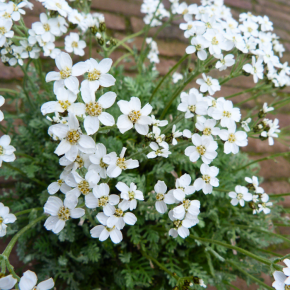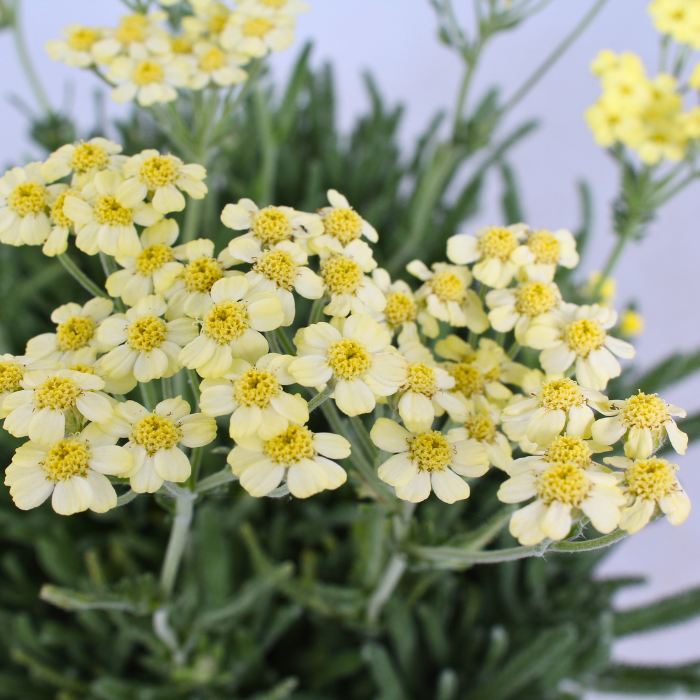
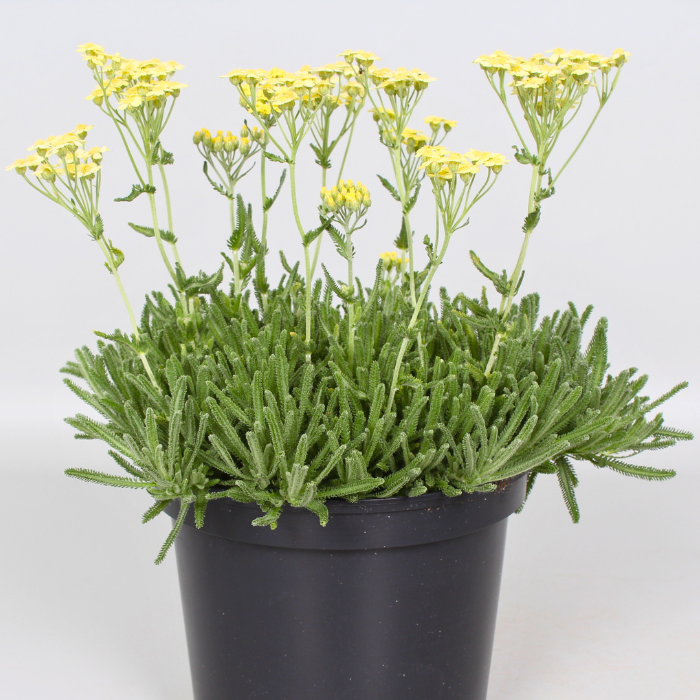
Achillea × lewisii King Edward, a horticultural hybrid derived from European mountain species, is a compact ground-covering yarrow. It differs from taller border yarrows through its very low habit, evergreen silver-grey foliage and moderate growth rate. Its buff-yellow flower heads, gradually fading to cream, bring a bright and refined effect to rock gardens, dry slopes and sunny borders.
|
Packaging
To find out more about our packaging, please visit our young plants' page available from the website header.

|
Available quantity | Dispo à partir de | Sold by | Desired quantity | |
|---|---|---|---|---|---|
|
Packaging
GT9
To find out more about our packaging, please visit our young plants' page available from the website header.
|
Available quantity 479 | Dispo à partir de Immédiat | Sold by min 10 |
|
|
Characteristics of Achillea × lewisii King Edward
Achillea × lewisii ‘King Edward’, commonly known as ‘King Edward’ yarrow, belongs to the Asteraceae family. This hybrid between Achillea tomentosa and Achillea clavennae gradually forms a dense mat of finely divided leaves. Olive-green in winter, the foliage develops a whitish covering in spring, giving it a distinctive silver-grey appearance. The flowering stems, approximately 15 cm high, carry compact buff-yellow flower heads that fade to cream. The plant is hardy and drought-resistant but does not tolerate heavy, compact soils or prolonged winter moisture.
How to use Achillea × lewisii King Edward ?
Achillea × lewisii ‘King Edward’ is suitable for rock gardens, gravel gardens, dry borders, slopes, retaining walls and lightly used paved areas. Its spreading habit makes it an effective, luminous ground cover in sunny locations where taller plants would be unsuitable. It can also be grown in troughs, alpine containers or extensive green roofs with a sufficiently free-draining substrate. Its good tolerance of limestone, coastal exposure and drought makes it valuable in Mediterranean-style and seaside landscapes. It combines effectively with thymes, sedums, nepetas, artemisias and small ornamental grasses adapted to dry conditions.
What advice ensures successful cultivation of Achillea × lewisii King Edward ?
Plant Achillea × lewisii ‘King Edward’ in spring or early autumn, in full sun and in poor to moderately fertile, sandy, stony or calcareous soil. Excellent drainage is essential, especially during winter. Allow approximately 35 to 40 cm between plants, corresponding to around six plants per square metre. Water thoroughly at planting and regularly during the first few weeks. Once established, the plant generally requires little additional irrigation. Avoid nitrogen-rich fertilisers, which may reduce the compactness of the foliage. Remove faded flowers and lightly clean the clumps at the end of winter.