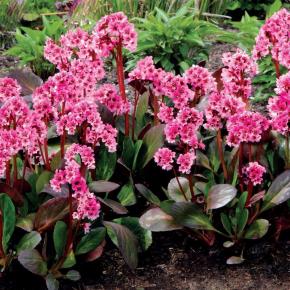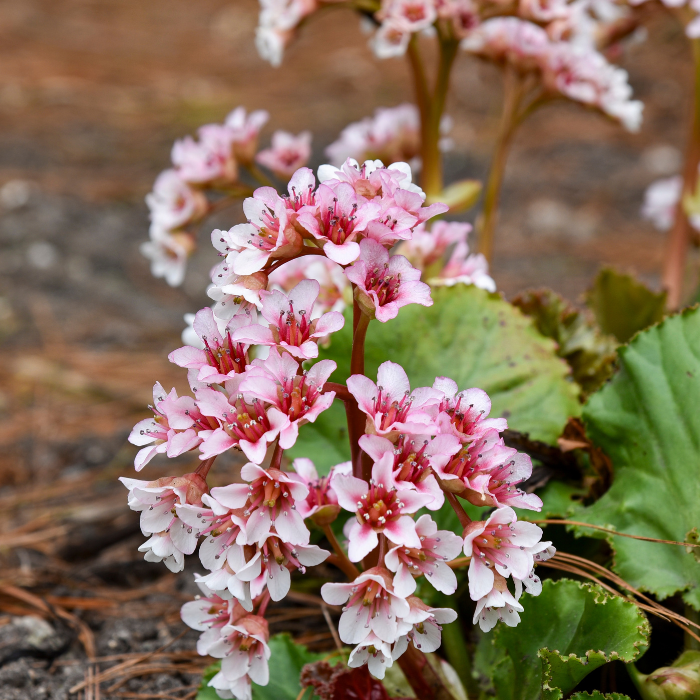
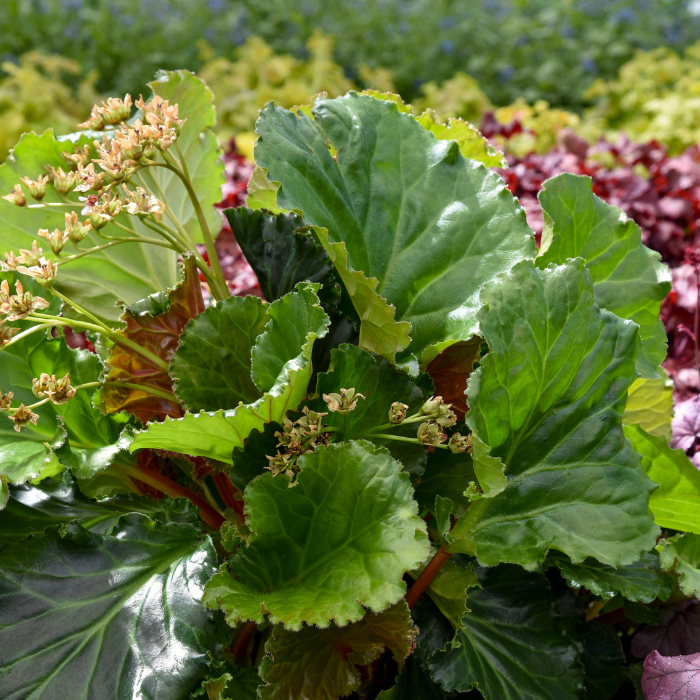
Bergenia ‘Ripple Effect’®, a horticultural hybrid bred in the United States from Bergenia ciliata ‘Susan Ryley’ and a selection of Bergenia pacumbis, is distinguished by its glossy leaves, which can reach 35 cm in width. Their strongly rippled margins create a bold architectural texture. Unlike most bergenias, its foliage dies back in winter. Its white flowers gradually develop a pink tinge.
|
Packaging
To find out more about our packaging, please visit our young plants' page available from the website header.

|
Available quantity | Dispo à partir de | Sold by | Desired quantity | |
|---|---|---|---|---|---|
|
Packaging
GT9
To find out more about our packaging, please visit our young plants' page available from the website header.
|
Available quantity 46 | Dispo à partir de Immédiat | Sold by min 10 |
|
|
|
Packaging
GT9
To find out more about our packaging, please visit our young plants' page available from the website header.
|
Available quantity 274 | Dispo à partir de Immédiat | Sold by min 10 |
|
|
The stated dimensions represent the average mature size reported for this cultivar. Its hardiness is based on a USDA Zone 5 classification.
Characteristics of Bergenia ‘Ripple Effect’®
This bergenia forms a vigorous rhizomatous clump composed of very large, leathery, rounded to broadly obovate leaves. The glossy green leaf blades commonly measure close to 30 cm and feature crenated, ciliate and strongly rippled margins. This large foliage clearly distinguishes ‘Ripple Effect’® from more compact cultivars. The plant becomes dormant after the first frosts and produces new growth in spring. From March to May, branched inflorescences carry numerous bell-shaped flowers, initially white and gradually becoming lightly tinged with pink as they age. The flowering stems may also be used in fresh floral arrangements.
How to use Bergenia ‘Ripple Effect’®?
Its broad foliage provides strong structure in shaded borders, woodland edges, open woodland and architectural planting schemes. Position it at the front or middle of a border, either as a specimen or in groups, allowing sufficient space for its rhizomes to spread. It combines well with ferns, hostas, brunneras, heucheras and ornamental grasses suited to partial shade. It may also be used to cover the ground beneath deciduous shrubs or to edge a pathway. Container cultivation is possible in a wide, stable and well-drained pot with a capacity of at least 20–30 litres.
What are the recommended cultivation practices for Bergenia ‘Ripple Effect’®?
Plant this bergenia in spring or autumn in humus-rich, moisture-retentive and well-drained soil. Partial shade encourages the development of its large leaves, while bright shade is also suitable. Full sun may be used in cooler climates where the soil retains consistent moisture. Allow 80–90 cm between plants. Position the crown just below soil level, then water regularly during establishment and throughout dry periods. Avoid standing water and compacted soils. Apply mature compost in spring. Remove damaged leaves and divide clumps that have become too wide in early spring.