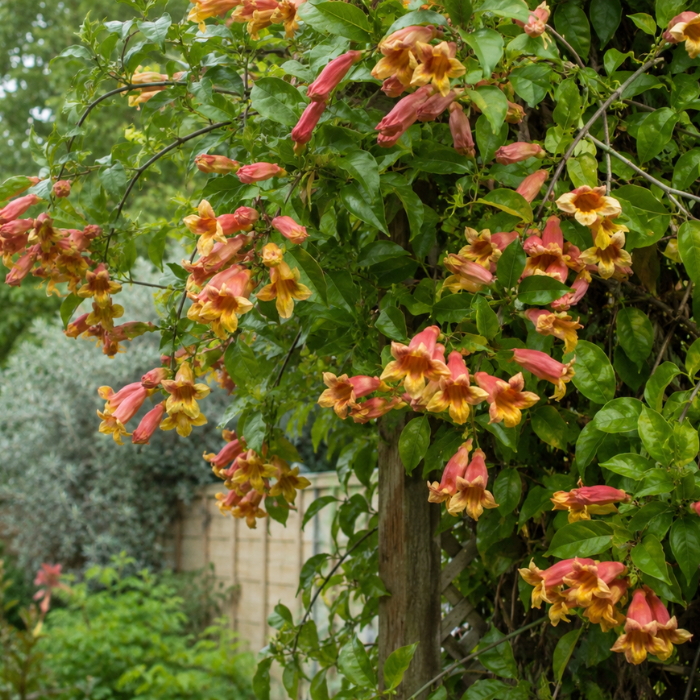
Bignonia capreolata, native to the central and eastern United States, is a climbing vine with evergreen foliage in mild climates. It differs from Campsis radicans through its fragrant spring flowers, leathery leaves and tendrils ending in adhesive discs. Its orange to red trumpet-shaped flowers, opening widely around a yellow throat, quickly cover sturdy supports.
|
Packaging
To find out more about our packaging, please visit our young plants' page available from the website header.

|
Available quantity | Dispo à partir de | Sold by | Desired quantity | |
|---|---|---|---|---|---|
|
Packaging
GT9
To find out more about our packaging, please visit our young plants' page available from the website header.
|
Available quantity 400 | Dispo à partir de 10/2026 | Sold by min 10 |
|
|
|
Packaging
POT11
To find out more about our packaging, please visit our young plants' page available from the website header.
|
Available quantity 306 | Dispo à partir de Immédiat | Sold by min 10 |
|
|
The foliage may become semi-evergreen or deciduous during cold winters. The stated dimensions represent an average mature size, and growth can be restricted by pruning.
Characteristics of Bignonia capreolata
This woody climber produces long stems equipped with branched tendrils ending in small adhesive discs, allowing it to cling to rough surfaces. Its opposite leaves consist of two leathery, oval, dark green leaflets. They often develop bronze to reddish-purple tones in cold weather. In May and June, clusters of tubular orange-red flowers with yellow throats appear along the stems. Their fragrance may be reminiscent of coffee or chocolate. Its spring flowering, evergreen foliage in mild climates and tendril-based attachment distinguish this species from trumpet vines belonging to the genus Campsis.
How to use Bignonia capreolata?
This climber is suitable for covering a pergola, arbour, wire fence, boundary fence or large trellis. It may also be grown against a wall, provided that the surface is sound and the mortar joints can withstand its adhesive discs. On a fragile façade, install a separate, sturdy support structure. Its dense foliage can form a seasonal or evergreen screen, depending on the climate. Allow sufficient space, as its stems can reach several metres in length. Container cultivation is possible in a pot of at least 50 litres, but regular pruning and careful irrigation monitoring are required.
What are the recommended cultivation practices for Bignonia capreolata?
Plant in spring in a sunny, warm position sheltered from cold winds. Partial shade is tolerated, although a bright exposure improves flowering. Choose fertile, humus-rich, moisture-retentive and well-drained soil. Position the root ball 30–50 cm away from the support and allow approximately 2.5 m between plants. Water regularly during the first two growing seasons, then during prolonged dry periods. An application of mature compost in spring supports growth without encouraging excessive foliage. Train young stems onto the support during establishment. Prune after flowering to control growth and remove any unwanted shoots.