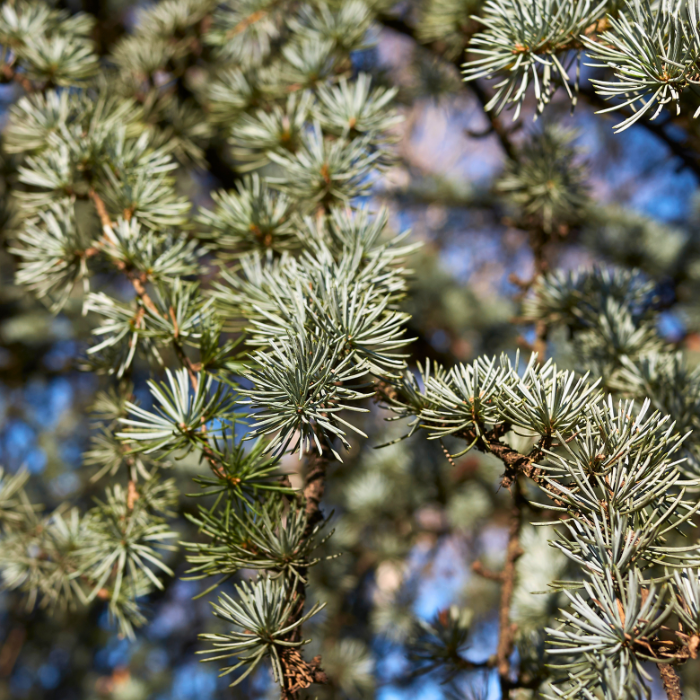
Cedrus atlantica, native to the mountain ranges of Morocco and Algeria, is a large evergreen conifer commonly known as the Atlas cedar. More pyramidal than the cedar of Lebanon when young and without the drooping leading shoot of the Himalayan cedar, it gradually develops a broad, table-shaped crown supported by powerful horizontal branches.
|
Packaging
To find out more about our packaging, please visit our young plants' page available from the website header.

|
Available quantity | Dispo à partir de | Sold by | Desired quantity | |
|---|---|---|---|---|---|
|
Packaging
AF350
To find out more about our packaging, please visit our young plants' page available from the website header.
|
Available quantity 700 | Dispo à partir de 10/2026 | Sold by 40 |
|
|
The stated dimensions represent the average mature size observed in cultivation. This conifer does not produce true flowers: its reproductive structures are male and female cones that appear in autumn.
Characteristics of Cedrus atlantica
The Atlas cedar initially forms a conical tree with a straight leading shoot, before its crown broadens and becomes more irregular with age. Its short, stiff and slightly curved needles are grouped in clusters on short shoots. Their colour ranges from green to grey-green; strongly blue forms generally belong to horticultural selections within the Glauca Group. The upright, cylindrical female cones change from green to brown and mature over two to three years before disintegrating on the tree. The male cones release their pollen mainly in September and October.
How to use Cedrus atlantica?
Its size and imposing silhouette make Cedrus atlantica primarily suitable for parks, large gardens, estates and landscaped spaces with sufficient room. It is best planted as a specimen on a lawn or within an open vista, allowing its horizontal branches to develop fully. It may also be planted in widely spaced avenues or incorporated into a conifer collection. Its growth and root system are unsuitable for small gardens, clipped hedges or long-term container cultivation. Position it well away from buildings, overhead services and narrow circulation areas.
What are the recommended cultivation practices for Cedrus atlantica?
Plant this cedar in full sun, in deep, well-drained soil that may be acidic, neutral or alkaline. Avoid permanently waterlogged ground and positions exposed to strong winds. Allow 10–12 m between trees and preferably use young container-grown plants, as established specimens do not transplant readily. Water regularly during the first two or three years, then irrigate during prolonged dry periods. A surface application of mature compost is sufficient in poor soils; avoid excessive nitrogen fertilisation. Routine pruning is unnecessary: remove only dead, damaged or poorly positioned wood.