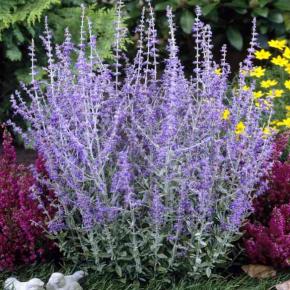
Perovskia atriplicifolia Prime Time® is a modern cultivar offering a compact habit, earlier bloom time, and more abundant flowering than traditional Russian sage varieties. Native to Central Asia, this drought-tolerant subshrub is perfectly suited to xeriscaping and hot, dry climates, combining ornamental value with exceptional resilience.
|
Packaging
To find out more about our packaging, please visit our young plants' page available from the website header.

|
Available quantity | Dispo à partir de | Sold by | Desired quantity | |
|---|---|---|---|---|---|
|
Le stock n'est actuellement pas disponible pour ce produit. |
|||||
Characteristics of Perovskia atriplicifolia Prime Time®
Native to the arid steppes of Central Asia, Perovskia atriplicifolia Prime Time® is a compact, floriferous selection of Russian sage. This variety forms a dense, upright mound with finely divided, aromatic foliage in a striking silvery tone. Its key advantage lies in its early and extended blooming period, beginning in June, with abundant lavender-blue flower spikes that attract pollinators throughout summer. The uniform growth habit and vibrant display make it a valuable asset for professional landscape designs.
How to Use Perovskia atriplicifolia Prime Time® ?
Perovskia Prime Time® is ideal for dry borders, Mediterranean-style gardens, or low-maintenance urban landscapes. It can be used in mass plantings, mixed perennial beds, or as a low hedge. Suitable for containers as well, it adds a soft, textured look to terraces and patios. When combined with ornamental grasses or drought-tolerant perennials, it helps create structured, resilient planting schemes. It is also an effective alternative to lavender in full-sun, low-water designs.
Best Practices for Growing Perovskia atriplicifolia Prime Time® ?
Perovskia Prime Time® thrives in well-drained, light soils, including poor or rocky substrates. Plant in full sun with 50 cm spacing between specimens. Once established, it requires minimal irrigation and is highly tolerant of drought. A hard prune in late winter (down to 10–15 cm) promotes vigorous regrowth and dense flowering. Fertilization is unnecessary, making it an excellent choice for sustainable landscaping or low-intervention plantings.