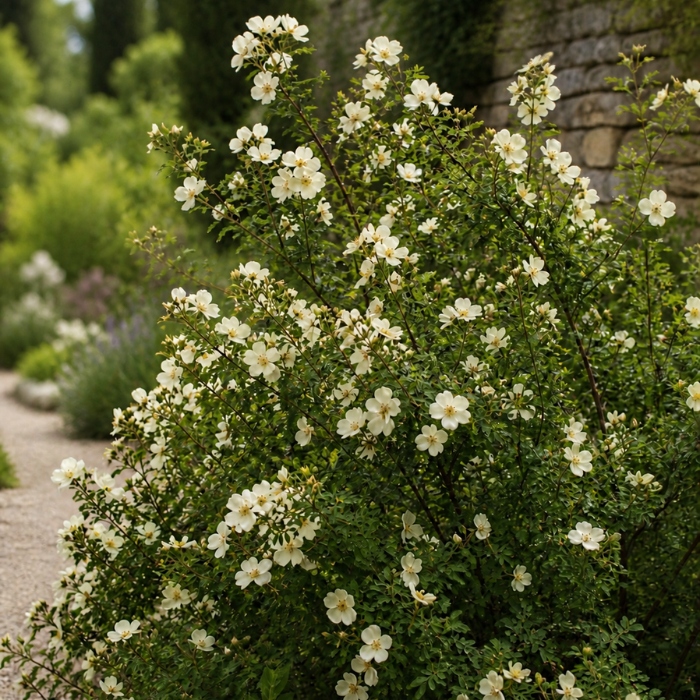
Rosa pimpinellifolia, native to Europe and also found in parts of western Asia and North Africa, is a compact botanical rose with a strongly suckering habit. The burnet rose is distinguished by its finely divided foliage, simple creamy-white flowers and, above all, its globose dark purple to almost black hips, which are particularly characteristic of the species.
|
Packaging
To find out more about our packaging, please visit our young plants' page available from the website header.

|
Available quantity | Dispo à partir de | Sold by | Desired quantity | |
|---|---|---|---|---|---|
|
Packaging
GT9
To find out more about our packaging, please visit our young plants' page available from the website header.
|
Available quantity 50 | Dispo à partir de 04/2027 | Sold by min 10 |
|
|
|
Packaging
GT9
To find out more about our packaging, please visit our young plants' page available from the website header.
|
Available quantity 230 | Dispo à partir de Immédiat | Sold by min 10 |
|
|
|
Packaging
GT9
To find out more about our packaging, please visit our young plants' page available from the website header.
|
Available quantity 135 | Dispo à partir de Immédiat | Sold by min 10 |
|
|
Characteristics of Rosa pimpinellifolia
Rosa pimpinellifolia forms a dense shrub around 1 m high and can gradually spread through suckering. Its stems bear numerous prickles, while the deciduous foliage consists of small, toothed leaflets that give the plant a fine texture. The simple flowers, usually creamy white with conspicuous yellow stamens, appear mainly in May and June. They are followed by rounded hips that become almost black when ripe, a distinctive feature compared with the red hips of many other botanical roses. Highly hardy, the species is well suited to exposed sites and performs best in adequately drained soils.
How to use Rosa pimpinellifolia?
Thanks to its dense habit and suckering growth, Rosa pimpinellifolia is particularly suitable for informal hedges, defensive hedges, shrub borders and extensive landscape plantings. It can also be used on banks and slopes or allowed to develop gradually into thickets. Its spreading root system should, however, be taken into account where space is limited. The species works especially well in naturalistic or countryside-style planting schemes and in projects requiring a compact botanical rose. Its tolerance of sandy, chalky or loamy, well-drained soils makes it suitable for a wide range of landscape situations, including relatively exposed sites.
What are the key cultivation tips for Rosa pimpinellifolia?
Plant Rosa pimpinellifolia in sun or partial shade, in well-drained soil. The species tolerates sandy, loamy and chalky soils and adapts to a broad pH range. For continuous planting, allow approximately 1 m between plants, adjusting the spacing according to the desired landscape effect. Water regularly during establishment, then adapt irrigation to rainfall and soil conditions. Mulching can help reduce evaporation and competition from weeds. Pruning mainly consists of removing dead wood, controlling unwanted suckers and occasionally renewing older stems. A moderate application of well-decomposed organic matter can be beneficial in poor soils.