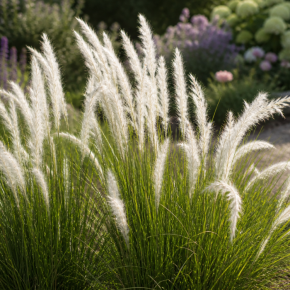
Stipa capillata, native to Europe and temperate regions of Asia, is a perennial grass of dry grasslands and steppes, commonly known as needle grass. It is distinguished by its very fine foliage and especially by its long hair-like awns carried on airy inflorescences. More upright and structured than Stipa tenuissima, it brings movement and lightness to sunny plantings in well-drained soils.
|
Packaging
To find out more about our packaging, please visit our young plants' page available from the website header.

|
Available quantity | Dispo à partir de | Sold by | Desired quantity | |
|---|---|---|---|---|---|
|
Packaging
P40 A7
To find out more about our packaging, please visit our young plants' page available from the website header.
|
Available quantity 2000 | Dispo à partir de Immédiat | Sold by 40 |
|
|
Characteristics of Stipa capillata
Stipa capillata is a perennial grass in the Poaceae family, forming a dense clump of narrow, fine and often rolled leaves. In summer, upright flower stems rise above the foliage and carry light, open panicles. The spikelets are extended by long, fine and flexible awns, characteristic of the species, which give the inflorescences a soft, airy appearance and enhance their movement in the wind. The plant reaches around 80 cm in height when in flower. Naturally adapted to dry grasslands, steppes and calcareous habitats, it has good cold tolerance when grown in soil that remains well drained during winter.
How to use Stipa capillata?
Stipa capillata is particularly well suited to gravel gardens, rock gardens, dry slopes, grass borders and steppe-style or naturalistic planting schemes. Its upright habit creates light vertical lines without forming an overly dense mass. Planted in groups, it strengthens the visual movement created by its long awns in the slightest breeze. It combines well with sun-loving perennials adapted to dry soils, including sages, yarrows and globe thistles. Its moderate size also allows it to be grown in large containers, provided drainage is efficient and the position is very bright.
What are the best cultivation practices for Stipa capillata?
Plant Stipa capillata in full sun, in light, poor to moderately fertile and very well-drained soil. Calcareous, stony or sandy soils are particularly suitable. Allow approximately 40 to 50 cm between plants. Water regularly after planting to encourage root establishment, then reduce irrigation once the clump is well established. Avoid excessive watering and soils that remain wet in winter. Heavy fertilisation is unnecessary and can encourage overly soft growth. In late winter, comb through the clump or remove dry leaves rather than routinely cutting all the foliage back.