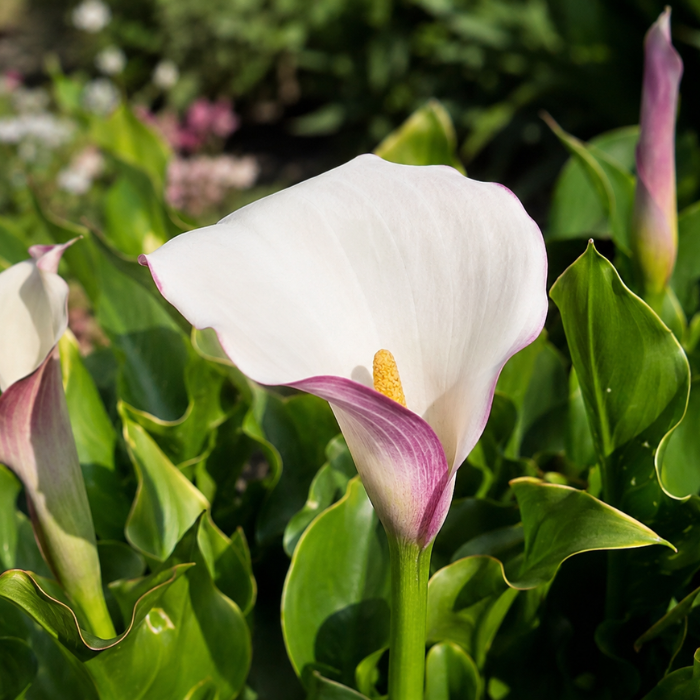
Zantedeschia Purple White®, from a genus native to southern Africa, is a tuberous perennial calla lily distinguished by its striking bicoloured spathes. The deep purple outer section contrasts with a bright white centre. More compact than traditional calla lilies, it is particularly well suited to containers, borders and summer planting schemes.
|
Packaging
To find out more about our packaging, please visit our young plants' page available from the website header.

|
Available quantity | Dispo à partir de | Sold by | Desired quantity | |
|---|---|---|---|---|---|
|
Le stock n'est actuellement pas disponible pour ce produit. |
|||||
Characteristics of Zantedeschia Purple White®
Zantedeschia Purple White® is a tuberous perennial forming a compact clump of broad, upright green leaves. Its main feature is its distinctive inflorescences, carried on sturdy stems: the spathes display a strong contrast between purple and white around a pale spadix. The plant generally reaches around 40 to 60 cm in height and maintains a relatively compact habit, making it particularly suitable for container growing. Flowering occurs mainly in summer. The foliage dies back during the dormant period. As it is only moderately hardy, the tubers should be protected from severe frost in regions with cold winters.
How to use Zantedeschia Purple White®?
Thanks to its compact habit and highly decorative bicoloured flowers, Zantedeschia Purple White® is suitable for flowering containers, terraces, borders and the front of summer beds. Growing it in containers highlights the purple and white spathes and also makes winter protection easier in colder regions. In open ground, it fits well into summer planting schemes in sunny or lightly shaded positions. Its flower stems can also be used as cut flowers. For a stronger visual effect, it can be planted in groups or combined with ornamental foliage perennials.
What are the best cultivation practices for Zantedeschia Purple White®?
Plant Zantedeschia Purple White® in fertile, humus-rich and well-drained soil that remains evenly moist during the growing season without becoming waterlogged. Choose a sunny to partially shaded, sheltered position. In borders, allow approximately 30 to 40 cm between plants. Water regularly during active growth and flowering, then gradually reduce watering as the foliage enters dormancy. Regular feeding during the growing season supports healthy development and flowering. Remove faded flowers, but allow the foliage to yellow naturally. In regions exposed to severe frost, lift and overwinter the tubers or move container-grown plants to a frost-free location.