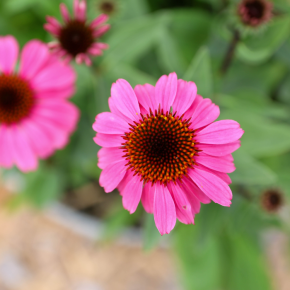
Osteospermum ecklonis ‘Stardust’, derived from a species native to South Africa, is a perennial Cape daisy with a spreading habit. This cultivar stands out for its large pinkish-purple flower heads with mauve tones, contrasting with its dark green foliage. Its dense growth and abundant summer flowering make it particularly suitable for sunny beds, borders, rock gardens and containers.
|
Packaging
To find out more about our packaging, please visit our young plants' page available from the website header.

|
Available quantity | Dispo à partir de | Sold by | Desired quantity | |
|---|---|---|---|---|---|
|
Le stock n'est actuellement pas disponible pour ce produit. |
|||||
Characteristics of Osteospermum ecklonis ‘Stardust’
Osteospermum ecklonis ‘Stardust’ forms a spreading mound approximately 45 cm high, covered with dark green evergreen foliage. Its large daisy-like flowers have pinkish-purple petals with mauve to lavender tones, giving the display a particularly bright appearance. Flowering occurs mainly from June to September, with the best performance achieved in full sun. Its hardiness is limited to around -5°C, meaning that long-term outdoor cultivation is mainly suited to mild, sheltered locations. It performs particularly well in warm, sunny positions protected from cold winds.
How to use Osteospermum ecklonis ‘Stardust’?
Thanks to its spreading habit, Osteospermum ecklonis ‘Stardust’ is suitable for flower beds, borders, rock gardens, pots and window boxes. In open ground, it can be planted at the front of a sunny border or alongside paths, where its vegetation gradually develops into a dense mound. It can also be used in gardens exposed to maritime conditions. In containers, its pinkish-purple flowers combine well with white, pink or purple flowering plants. In regions regularly experiencing temperatures below -5°C, it is mainly grown as a seasonal plant or overwintered in a bright, frost-free location.
What are the best growing tips for Osteospermum ecklonis ‘Stardust’?
Plant Osteospermum ecklonis ‘Stardust’ in full sun, in fertile, well-drained soil. The cultivar can also tolerate calcareous soils provided drainage is adequate. Allow approximately 40 cm between plants, corresponding to a planting density of around six plants per square metre. Water regularly during establishment, then moderately, avoiding prolonged waterlogging. In containers, adjust watering according to substrate moisture and provide fertiliser during the growing and flowering season. Remove faded flower heads regularly to encourage further flowering. Light pruning can help maintain a compact mound. In colder climates, protect the root system or overwinter container-grown plants in frost-free conditions.